

Efficiency. Productivity. Savings.
What costs can we cut with AI? This is the question most organizations are trying to answer. At the same time, boards, economists, and governments are asking why revenue isn’t growing and why economic productivity and GDP are stagnating.
One Truth
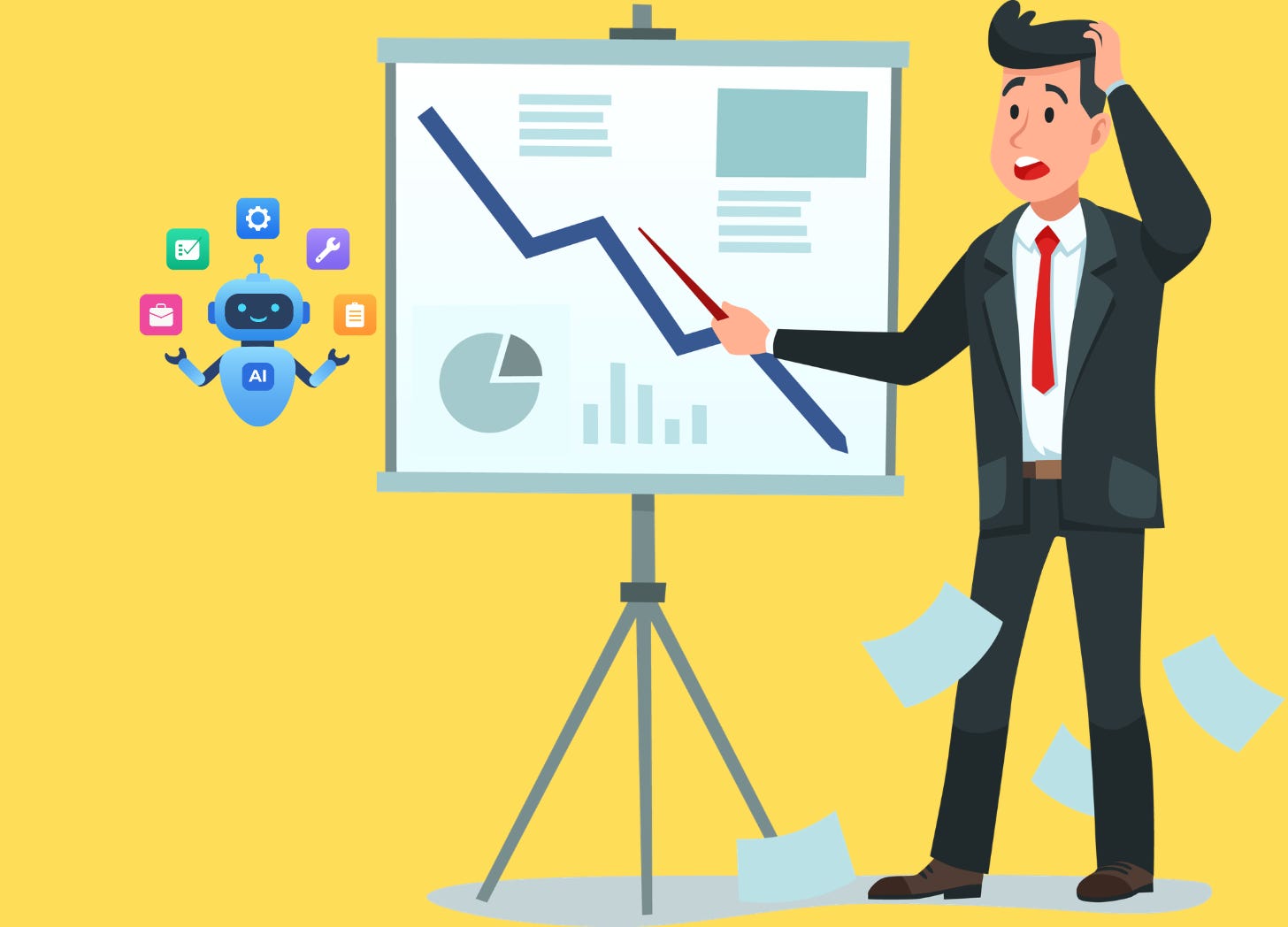
You cannot cost cut your way into revenue growth and increased economic productivity. Yes, cost cutting will provide a short term boost to business profits but year over year, it’s not a sustainable business strategy.
AI can help reduce costs. In every organization, there are low or no value-add tasks that are done by skilled, capable humans. And when we free those humans from the low- or no-value-add tasks, what do we do with that extra capacity?
Well, the answer to that right now appears to be that we lay them off. We pat ourselves on the back for the boost in short-term profitability while simultaneously talking about the lack of growth and productivity.
We’ve framed the entire AI conversation on cost cutting and cost savings, that we are entirely missing the growth opportunities it can create.
One Insight
The question we need to be asking of AI is twofold.
Where can AI help us cut costs AND how do we use the savings to fuel growth?
For over a decade now, I have been doing organizational research; I’ve spoken to more than 1,000 people, and I can tell you there are lots of amazing ideas to grow revenue right within your organization. People want to contribute more than they are currently allowed or able to. And AI presents an opportunity to do more. It allows us to create capacity to achieve the things that we never had time to get around to.
But the only way to do that is if we are brave enough to forego the short-term profit boosts and reinvest the savings into growth.
Insight into Action
Sometimes turning insight into action requires inspiration. So, here is a real-life example you may have missed in the headlines.
In 2021, IKEA rolled out a customer service chatbot called Billie. Billie absorbed the repetitive, tedious questions like: Where’s my order? How do I return this? These types of questions accounted for almost half of all customer queries. Billie saved IKEA roughly €13 million. And the traditional script would say to bank the savings and lay off the human customer service agents. But IKEA didn’t follow the script.
IKEA retrained 8,500 employees who would have been jobless to be virtual interior design consultants. Why did they do this? Because when IKEA started to look at the questions that Billie couldn’t handle, they saw a pattern, and then they saw the opportunity.
The questions Billie couldn’t answer were design-related. Customers wanted design advice. What might happen if customers could access design help virtually? That was the opportunity.
Rather than laying off the 8,500 people whose work Billie had absorbed, IKEA retrained them to be remote interior design advisors. Now, that remote design channel generates around €1.3 billion a year.
IKEA could have followed the traditional script. They could have banked the €13 million in savings and patted themselves on the back for boosting short-term profit. Instead, they looked for the growth opportunity. It’s this opportunity piece that most organizations miss…or skip.
Get Unstuckifyed
The world right now feels doom and gloom. Economies around the world are struggling, and job losses are dominating the headlines. These conditions force us into a scarcity mindset.
A scarcity mindset causes our brains to be hyper-focused on deficits, believing that resources are fixed and limited. In this state, cognitive biases such as loss aversion take hold, and we desperately cling to whatever gives us a sense of security. Even if that sense of security is only an illusion.
And we are never going to get Unstuckifyed in with a scarcity mindset.
Getting Unstuckifyed requires an abundance mindset. It requires believing that better is possible. And that’s what IKEA did…they believed better than €13 million in cost savings was possible.
The belief that better was possible didn't make IKEA immune to the harsh economic conditions every organization is facing right now. They've since had to make cuts elsewhere in the business. But how much better does a company ride out the down cycles when it's also focused on growth?
Till Next Time
We are never going to cut our way into growth. If we want to grow revenue, increase productivity, and GDP, we have to look beyond the short-term cost savings. We have to be brave enough to ask, where can AI help us save, and how can we use the savings to create growth?
Thanks for getting Unstuckifyed with me.
Dani
References
Ingka Group. (2023). AI and remote selling bring IKEA design expertise to the many. Ingka Group Newsroom. https://www.ingka.com/newsroom/ai-and-remote-selling-bring-ikea-design-expertise-to-the-many/
Reuters. (2023, June 13). IKEA bets on remote interior design as AI changes sales strategy. https://www.reuters.com/technology/ikea-bets-remote-interior-design-ai-changes-sales-strategy-2023-06-13/